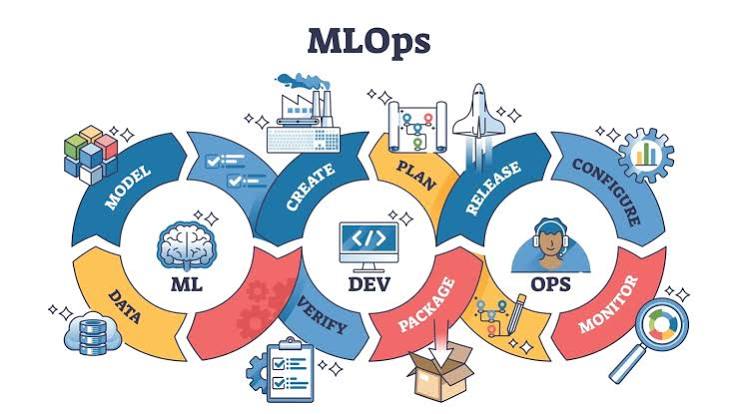
Organizations can build a machine learning model that performs well in an experiment and still fail to deliver a reliable AI product. Production success requires much more than model training: it requires controlled data pipelines, reproducible experiments, automated testing, versioned models, secure deployment, observability, feedback loops, and accountable operations.
DevOps provides the foundation for repeatable software delivery. MLOps extends that foundation to the additional complexities of machine learning, where data, model artifacts, training procedures, infrastructure, and production behavior all influence system performance.
This paper proposes an integrated engineering and commercialization framework in which:
- IAS-Research.com leads applied research, AI architecture, model evaluation, feasibility studies, and domain-specific innovation.
- KeenComputer.com engineers, integrates, deploys, secures, and operates production-grade software and MLOps infrastructure.
- KeenDirect.com provides a commercial channel for AI-enabled digital products, ecommerce, customer workflows, product discovery, and data-informed business operations.
Together, the three organizations can help SMEs move from isolated AI experiments to measurable business outcomes through a repeatable lifecycle: discover → design → build → validate → deploy → monitor → improve → commercialize.
The central recommendation is to treat MLOps as an engineering and business capability—not simply a collection of AI tools.
Research White Paper
IAS-Research.com · KeenComputer.com · KeenDirect.com | October 2026
From DevOps to MLOps: Engineering, Deploying, and Commercializing End-to-End Machine Learning Systems
A practical research and implementation framework for SMEs, software engineering teams, AI startups, and industrial organizations
9
Reference publication: DevOps to MLOps Bootcamp: Build, Deploy ML Systems End-to-End — Packt Publishing. View the publisher's book page.
Prepared for: IAS-Research.com, KeenComputer.com, and KeenDirect.com Research orientation: Software engineering, AI/ML systems, DevOps, MLOps, data engineering, platform operations, and SME commercialization.
Executive summary
Organizations can build a machine learning model that performs well in an experiment and still fail to deliver a reliable AI product. Production success requires much more than model training: it requires controlled data pipelines, reproducible experiments, automated testing, versioned models, secure deployment, observability, feedback loops, and accountable operations.
DevOps provides the foundation for repeatable software delivery. MLOps extends that foundation to the additional complexities of machine learning, where data, model artifacts, training procedures, infrastructure, and production behavior all influence system performance.
This paper proposes an integrated engineering and commercialization framework in which:
- IAS-Research.com leads applied research, AI architecture, model evaluation, feasibility studies, and domain-specific innovation.
- KeenComputer.com engineers, integrates, deploys, secures, and operates production-grade software and MLOps infrastructure.
- KeenDirect.com provides a commercial channel for AI-enabled digital products, ecommerce, customer workflows, product discovery, and data-informed business operations.
Together, the three organizations can help SMEs move from isolated AI experiments to measurable business outcomes through a repeatable lifecycle: discover → design → build → validate → deploy → monitor → improve → commercialize.
The central recommendation is to treat MLOps as an engineering and business capability—not simply a collection of AI tools.
1. Research objectives and scope
This white paper develops an actionable framework around six questions:
- How should an organization evolve from traditional DevOps to MLOps?
- What architecture and procedures are needed to build and deploy machine learning systems end to end?
- How can software engineering, data engineering, ML engineering, security, and operations work together?
- How should organizations test, monitor, retrain, govern, and improve production models?
- How can small and medium-sized enterprises implement these practices without adopting excessive infrastructure?
- How can IAS-Research.com, KeenComputer.com, and KeenDirect.com form an integrated delivery and commercialization partnership?
The paper is an independent technical synthesis inspired by the subject of the Packt publication. It is not a reproduction of the book, and the publisher's page is the bibliographic starting point rather than evidence that every technique discussed here appears in that book.
2. From DevOps to MLOps: the evolution of production AI
2.1 Traditional DevOps
DevOps integrates software development and IT operations to shorten delivery cycles while improving reliability. Its core practices include:
- Version control and collaborative code review.
- Automated builds and tests.
- Continuous integration and continuous delivery (CI/CD).
- Infrastructure as code (IaC).
- Containerization and environment consistency.
- Monitoring, incident response, and controlled releases.
For conventional software, the team usually deploys a defined code artifact and its dependencies. Changes in business logic or infrastructure trigger a release pipeline.
2.2 Why machine learning requires more
Machine learning introduces additional sources of change and uncertainty.
A model can become less useful even when its application code remains unchanged. The input population may change, data quality can deteriorate, or the relationship between input features and target outcomes may shift.
MLOps extends DevOps with:
- Data validation and data lineage.
- Feature engineering and feature consistency.
- Reproducible training and experiment tracking.
- Dataset, parameter, code, and model versioning.
- Statistical and business-performance evaluation.
- Model registries and approval workflows.
- Model-specific monitoring and retraining.
- Governance for AI risk, privacy, fairness, and explainability.
The Packt course provides a useful learning structure for this transition, covering environment setup, a house-price prediction use case, experiment tracking, model-serving infrastructure, monitoring, autoscaling, and GitOps-based deployment.
Premium
+1
2.3 DevOps versus MLOps
|
Dimension |
DevOps |
MLOps |
|---|---|---|
|
Primary artifact |
Application code and build |
Code, data, features, model, configuration |
|
Testing |
Unit, integration, acceptance |
All software tests plus data and model validation |
|
Release trigger |
Code or configuration change |
Code, data, model, or policy change |
|
Performance |
Latency, availability, errors |
Those metrics plus model quality and drift |
|
Reproducibility |
Source and build dependencies |
Source, dataset version, features, parameters, training environment |
|
Rollback |
Previous application release |
Compatible application, model, features, and configuration |
|
Continuous improvement |
Software releases |
Software releases plus validated model updates |
Important distinction: MLOps does not replace DevOps. It builds on DevOps and adds controls for the machine learning lifecycle.
2.4 Where LLMOps fits
LLMOps applies operational discipline to large language model applications, including retrieval-augmented generation (RAG), embeddings, prompt templates, vector databases, evaluation datasets, model endpoints, and inference costs.
Agentic AI systems add further requirements: tool permissions, workflow state, bounded actions, human approvals, execution traces, and protection against unsafe or unintended actions.
A mature organization may therefore maintain three related capabilities:
- DevOps: reliable software delivery and infrastructure operations.
- MLOps: reliable predictive and statistical machine learning systems.
- LLMOps and agent operations: controlled delivery of generative AI, RAG, and AI-agent workflows.
3. Reference architecture for an end-to-end MLOps platform
The following architecture is a proposed implementation blueprint for a small or medium-sized organization. It is not a claim that every component is mandatory.
1. Data sources and ingestion
Business applications · databases · files · sensors · APIs
2. Data validation and feature engineering
Schema checks · quality rules · transformations · feature definitions
3A. Experimentation
Training · validation · tuning · reproducible runs
3B. CI pipeline
Linting · unit tests · data tests · security checks
4. Experiment tracking and model registry
Metrics · artifacts · provenance · approvals · versioned models
5. Release gates and deployment
Acceptance tests · security review · staging · approval · production release
6. Model serving and business integration
REST API · web applications · ecommerce · internal systems · edge devices
7. Monitoring, feedback, and controlled improvement
Availability · latency · prediction quality · drift · costs · retraining decisions
Cross-cutting controls across every stage: identity and access management, secrets, encryption, audit logs, testing, observability, governance, backup, and disaster recovery.
3.1 Architecture components
|
Component |
Responsibility |
Candidate technologies |
|---|---|---|
|
Source control |
Version code, configuration, pipeline definitions |
Git, GitHub, GitLab |
|
Data ingestion |
Collect and transform business data |
Python, SQL, scheduled jobs, APIs |
|
Data quality |
Validate schema, completeness, ranges, and freshness |
Pandera, Great Expectations, custom checks |
|
Experiment tracking |
Record parameters, metrics, and artifacts |
MLflow |
|
Model registry |
Track model versions and promotion status |
MLflow Model Registry |
|
Packaging |
Build repeatable application and training environments |
Docker, Podman |
|
API serving |
Expose inference securely |
FastAPI, REST |
|
Continuous delivery |
Test and release software/model packages |
CI runners, GitOps tooling |
|
Infrastructure |
Provision environments and services |
Ansible, Terraform or equivalent |
|
Monitoring |
Observe service and model behavior |
Prometheus, Grafana, structured logs |
|
Orchestration |
Schedule pipelines and workloads |
Cron, workflow engines, Kubernetes when justified |
|
Business integration |
Consume predictions and expose business outcomes |
Joomla, WordPress, Magento, CRM, ecommerce APIs |
These are candidate components, not a mandate to deploy a large platform from day one. The appropriate design depends on the organization's data volume, model complexity, risk, team capabilities, and budget.
MLflow's documentation describes a model registry that supports model versioning, lineage, metadata, and controlled promotion, making it a useful building block for model lifecycle management.
MLflow AI Platform
+1
4. Engineering principles for a production-grade ML system
4.1 Reproducibility
Every production candidate should have a traceable record of:
- Source-code commit and dependency versions.
- Dataset reference, data extraction time, and transformation logic.
- Feature definitions and training parameters.
- Training environment and relevant hardware configuration.
- Evaluation dataset and evaluation results.
- Model artifact checksum and registry version.
- Approval record and deployment configuration.
Reproducibility does not mean that every training run will produce bit-identical outputs. Hardware, nondeterministic operations, and framework behavior can affect results. It means the team can establish what was run, with which inputs and configuration, and can explain material differences.
4.2 Separation of environments
Maintain separate development, staging, and production environments.
- Development: rapid experimentation with synthetic, anonymized, or otherwise approved data.
- Staging: production-like integration, security, performance, and acceptance testing.
- Production: approved, monitored, access-controlled workloads with backup and rollback procedures.
Credentials, data access, network privileges, and deployment permissions should be separated. Production data should not automatically be copied into developer laptops or test containers.
4.3 Model quality is not just accuracy
A model with high offline accuracy can still be commercially unsuitable.
A release evaluation should consider:
- Statistical performance appropriate to the task.
- False-positive and false-negative costs.
- Calibration and confidence where relevant.
- Performance across important customer or operating segments.
- Inference latency and throughput.
- Cost per prediction or completed transaction.
- Reliability under missing, malformed, or unusual inputs.
- Human review and fallback behavior.
A regression model might be evaluated using MAE or RMSE; a classifier might require precision, recall, F1, ROC-AUC, or precision-recall analysis. Metric selection must reflect the decision being supported, not whichever metric looks most impressive.
5. A step-by-step MLOps implementation procedure
The following workflow can be used as the foundation for an internal engineering standard or a client delivery engagement.
Suggested operating model: one accountable project owner, a documented acceptance criterion at each stage, and evidence retained for every production release.
Stage 1 — Define the business problem
Document the customer, operational problem, current baseline, intended decision, data availability, cost of errors, and expected financial or operational benefit.
Deliverable: problem statement, baseline KPI, feasibility assessment, and measurable acceptance criteria.
Exit gate: the use case has an owner, a valid business rationale, and a practical way to measure success.
Stage 2 — Assess and prepare the data
Inventory data sources, ownership, permissions, retention, quality, representativeness, and leakage risks. Build repeatable ingestion and validation jobs.
Deliverable: data dictionary, approved dataset, validation rules, lineage record, and a reproducible preparation pipeline.
Exit gate: data quality and access meet the agreed requirements; sensitive data is handled appropriately.
Stage 3 — Establish the baseline and train
Create a simple baseline model before attempting complex algorithms. Separate training, validation, and test datasets correctly. Record parameters, metrics, and artifacts for each experiment.
Deliverable: baseline comparison, training code, experiment records, and a selected candidate.
Exit gate: the candidate meets predefined statistical and business criteria on data not used for training.
Stage 4 — Build the automated CI pipeline
Trigger automated checks when code or pipeline definitions change. Run formatting, linting, type checks where useful, unit tests, data tests, dependency checks, and container-image scans.
Deliverable: version-controlled CI configuration, test reports, and build artifacts.
Exit gate: all required tests pass, and no unresolved critical security finding blocks release.
Stage 5 — Register and evaluate the model
Register the candidate model with its lineage and evaluation results. Compare it against the current production model or baseline. Add human approval where the risk requires it.
Deliverable: versioned model artifact, model card, test evidence, and promotion decision.
Exit gate: the model has passed technical, business, privacy, and risk-specific checks.
Stage 6 — Deploy to staging and production
Package the model behind a stable interface, such as a FastAPI REST endpoint. Test API contracts, authentication, input validation, concurrency, latency, error handling, and resource consumption.
Deploy to staging first. Release to production using a controlled strategy appropriate to the application, such as a canary release or a shadow deployment.
Deliverable: deployment manifest, API documentation, smoke-test results, rollback plan, and release record.
Stage 7 — Monitor and operate
Track service health, request latency, error rates, input-data quality, feature distributions, prediction distributions, business outcomes, and model performance when ground-truth labels become available.
Deliverable: dashboards, alerts, incident procedures, and periodic model reviews.
Exit gate: an identified owner can detect failures, investigate incidents, restore service, and determine whether retraining is justified.
Stage 8 — Improve and retrain under control
Investigate drift or deteriorating performance, validate new data, train a new candidate, compare it against the incumbent, and promote only after the release gates pass.
Deliverable: a documented retraining decision, new experiment lineage, and an approved release—or evidence that the existing model should be retained.
Exit gate: every model change is traceable and reversible.
5.1 Example CI/CD and model release policy
A practical pipeline should distinguish software delivery from model promotion.
|
Event |
Automated action |
Approval |
|---|---|---|
|
Pull request opened |
Lint, unit tests, data-contract tests, dependency scan |
Code reviewer |
|
Training job completed |
Evaluate metrics, persist artifacts and lineage |
Automated checks |
|
Model candidate registered |
Compare with baseline; validate risk criteria |
ML owner or designated reviewer |
|
Staging deployment |
API tests, load tests, security checks, smoke tests |
Release policy |
|
Production promotion |
Deploy approved immutable artifact |
Authorized release owner |
|
Performance degradation |
Alert, investigate, consider rollback or retraining |
Model owner under incident policy |
Do not automatically deploy every newly trained model. Automated retraining can be useful, but production promotion should depend on evidence, risk, and explicit acceptance rules.
6. Practical laboratory: build a reproducible house-price prediction service
The Packt course uses a house-price regression problem as an end-to-end learning use case and discusses Docker/Podman Compose, MLflow experiment tracking, Python project structure, and virtual environments.
Premium
+1
A comparable project is a useful foundation for an SME's first MLOps implementation because the workflow can be demonstrated without initially requiring GPU infrastructure or a complex distributed platform.
6.1 Define the use case
The objective is to estimate a property's sale price from permitted, relevant features such as property size, age, location attributes, and other validated characteristics.
The prediction is an estimate—not a certified appraisal, a guaranteed sale price, or a substitute for professional valuation.
Define the acceptance criteria before training. Illustrative requirements might include:
- A specified improvement in mean absolute error over a baseline.
- Acceptable error across defined property segments.
- An agreed inference-latency budget.
- A clear explanation of known limitations.
- No use of unauthorized or inappropriate personal data.
The actual thresholds must be determined using the data and business requirements.
6.2 Create a project structure
mlops-house-price/ ├── README.md ├── pyproject.toml ├── uv.lock ├── configs/ │ ├── development.yaml │ └── production.yaml ├── data/ │ └── README.md ├── notebooks/ │ └── exploration.ipynb ├── src/ │ └── house_price/ │ ├── data.py │ ├── features.py │ ├── train.py │ ├── evaluate.py │ └── api.py ├── tests/ │ ├── test_data.py │ ├── test_features.py │ └── test_api.py ├── docker/ │ └── Dockerfile ├── compose.yaml ├── .github/ │ └── workflows/ └── docs/ ├── model-card.md ├── runbook.md └── release-checklist.md
Keep notebooks for exploration and move repeatable production logic into tested modules. Never commit passwords, private datasets, model secrets, or sensitive customer records to Git.
6.3 Set up the local environment
On a supported Linux development machine, install Git, Python, a project environment manager such as uv, and Docker or Podman with Compose support. Pin and document the versions actually tested.
An illustrative initial workflow:
mkdir mlops-house-price cd mlops-house-price git init uv init uv add pandas scikit-learn mlflow fastapi uvicorn uv add --dev pytest ruff uv run pytest
These commands create a starting Python project and install example dependencies. They do not create a complete production pipeline; the application modules, tests, data pipeline, and configuration must still be implemented.
For a real deployment, lock dependencies, review transitive packages, build a reproducible container image, and run dependency and image-security checks.
6.4 Implement the data and training workflow
The pipeline should:
- Load an approved dataset using a documented schema.
- Validate required columns, types, missing values, and acceptable ranges.
- Split data to prevent leakage, accounting for time or geographical structure where relevant.
- Establish a baseline.
- Train one or more candidate regression models.
- Evaluate MAE and RMSE on an untouched test set.
- Log parameters, metrics, and artifacts to MLflow.
- Register a candidate only when it meets the release policy.
Use a fixed random seed where applicable and record the dataset reference and code revision. A saved model alone is insufficient for reliable reproducibility.
6.5 Expose a versioned REST API
A FastAPI service could expose an endpoint such as:
POST /v1/predictions GET /health GET /ready
A prediction request would provide validated property features; the response would contain the estimated price, model version, and any appropriate uncertainty or limitation metadata.
The API should enforce input validation, authentication, request limits, error handling, and appropriate logging. Avoid returning internal stack traces or exposing sensitive training information.
6.6 Containerize and deploy
Build the service as an immutable container image. Use Compose for a small local laboratory, with separate services for the API, experiment-tracking server, and any required database or artifact store.
For production:
- Use persistent storage and backups for tracking metadata and model artifacts.
- Keep secrets outside the image and source repository.
- Apply least-privilege service identities and network rules.
- Pin deployment versions and use health checks.
- Test recovery and rollback.
- Move to Kubernetes or a managed platform only when the operational requirements justify it.
6.7 Demonstrate the complete lifecycle
The lab is successful when a reviewer can trace one model from source code and dataset through training, evaluation, registration, deployment, inference, monitoring, and rollback.
That traceability is a stronger demonstration of MLOps maturity than a notebook showing only that a model achieved a particular score.
7. Monitoring, reliability, and continuous improvement
A production model is a live operational dependency. Monitoring must cover both the service and the quality of its decisions.
7.1 Four monitoring layers
Layer 1 — Infrastructure and service health
CPU, memory, disk, network, availability, API error rate, queue depth, container restarts, and saturation.
Layer 2 — Data and feature quality
Missing fields, schema changes, out-of-range values, unexpected distributions, stale inputs, and pipeline failures.
Layer 3 — Model quality
Prediction distributions, calibration, drift indicators, subgroup performance, and actual prediction errors once trustworthy ground truth becomes available.
Layer 4 — Business outcomes
Conversion, customer satisfaction, cost per transaction, avoided failures, productivity, revenue contribution, and return on investment.
7.2 Establish operational service-level objectives
A team should define service-level indicators (SLIs) and service-level objectives (SLOs) that reflect the intended application.
Illustrative targets for a non-critical internal prediction service might be:
|
Indicator |
Example initial target |
|---|---|
|
Monthly service availability |
99.5% |
|
API latency at the 95th percentile |
Under 300 ms |
|
Successful valid requests |
At least 99.5% |
|
Critical input-validation failures |
Zero accepted invalid inputs |
|
Model lineage for production releases |
100% traceable |
|
Tested rollback procedure |
Completed before launch |
These are planning examples, not measured results or universal recommendations. Latency should be measured under a defined workload, including cold starts where relevant. Business-critical and safety-related applications require a risk-appropriate standard.
7.3 Model drift and retraining
Three concepts must be distinguished:
- Data drift: the distribution of incoming inputs changes.
- Concept drift: the relationship between inputs and the target changes.
- Performance degradation: actual predictive performance deteriorates against reliable labels or outcomes.
Drift does not automatically mean a model needs retraining. A new input distribution may be harmless, and retraining on poor-quality or biased data can make a model worse.
Use a controlled decision process:
- Detect an anomaly and validate the monitoring signal.
- Investigate data quality, operational changes, and changes in the population.
- Compare recent performance with the agreed baseline.
- Decide whether to fix the data pipeline, retain the model, retrain, or fall back to a non-ML process.
- Validate any candidate against the incumbent.
- Deploy through the normal approval and rollback workflow.
8. Security, AI governance, and operational risk
MLOps security must address the entire lifecycle, not merely the API endpoint.
The NIST AI Risk Management Framework provides a useful foundation for organizing risk-management activities around governing, mapping, measuring, and managing AI risks.
NIST
8.1 Security control checklist
MLOps readiness checklist
0/12
Data security
Inventory datasets and document permitted uses.
Restrict access to sensitive data; encrypt data in transit and at rest.
Validate uploaded files, schemas, and external data sources.
Software supply chain
Pin dependencies and scan packages and container images.
Use reviewed source changes and protected release branches.
Secure credentials, CI runners, registries, and build artifacts.
Model security
Restrict access to training and production model artifacts.
Assess data poisoning, model tampering, and inappropriate model exposure.
Validate model inputs and define safe failure behavior.
Production governance
Maintain release approvals, audit records, and incident ownership.
Document limitations, intended use, and human-review requirements.
Test backup restoration, rollback, and disaster recovery.
Reset checklistCopy checklist
8.2 Generative AI and RAG require additional controls
For RAG-LLM systems and AI agents, the release policy should additionally address:
- Retrieval quality, source attribution, and evaluation of generated answers.
- Prompt injection and malicious or misleading retrieved content.
- Tenant isolation and access control at retrieval time.
- PII exposure, data retention, and model-provider terms.
- Tool permissions, bounded execution, and human approval for consequential actions.
- Token consumption, inference cost, rate limits, and fallback behavior.
- Evaluation against a representative and versioned test set.
A useful architectural principle is to keep retrieval, generation, authorization, and business actions as separate, testable components. The LLM should not be treated as an authorization system.
9. The strategic roles of IAS-Research.com, KeenComputer.com, and KeenDirect.com
The three organizations can form a complementary research-to-market partnership. The division of responsibilities below is a proposed operating model, not a claim that every listed service is already commercially deployed.
IAS-Research.com
Research, architecture, evaluation, and technical strategy
IAS-Research acts as the research and innovation partner, helping clients select valuable problems and establish technically defensible AI solutions.
- AI/ML feasibility studies and proof-of-concept development.
- Data strategy, feature engineering, and model selection.
- MLOps, LLMOps, RAG, and AI-agent architecture.
- Model evaluation, benchmarking, risk assessment, and documentation.
- Engineering research, technical white papers, and innovation roadmaps.
Primary deliverable: a validated, documented, and measurable AI solution design ready for engineering and commercialization.
KeenComputer.com
Implementation, integration, cybersecurity, and managed operations
KeenComputer converts the research architecture into a reliable system that can be deployed, secured, maintained, and supported.
- Git-based engineering workflows and CI/CD automation.
- Linux, Docker/Podman, API, database, and server engineering.
- MLflow integration, model-serving APIs, and monitoring.
- Infrastructure automation, backup, security hardening, and recovery.
- Integration with Joomla, WordPress, Magento, CRM, and existing SME applications.
- Production operations, incident response, and lifecycle support.
Primary deliverable: a tested, deployed, monitored, and supportable production service.
KeenDirect.com
Commercialization, ecommerce, and customer-facing AI applications
KeenDirect can provide a channel for turning AI capabilities into useful customer experiences and repeatable commercial offerings.
- AI-assisted product discovery and recommendations.
- Search, catalog enrichment, and product-content workflows.
- Demand forecasting and inventory decision support.
- Customer-service assistants grounded in approved product information.
- CRM and ecommerce analytics integrations.
- Productized AI solutions, service packages, and customer feedback loops.
Primary deliverable: an AI-enabled commercial offering connected to measurable customer and business outcomes.
9.1 The combined delivery model
IAS-Research.com
Identify opportunity, research, design, and validate
KeenComputer.com
Engineer, secure, deploy, and operate
KeenDirect.com
Commercialize, acquire customers, measure outcomes
Customer outcomes, operational data, and approved feedback inform the next research and engineering cycle.
This model can support both individual projects and longer-term engagements. A client might initially purchase an AI feasibility assessment, proceed to a fixed-scope implementation, and then subscribe to ongoing monitoring and support.
The organizations should establish clear ownership of intellectual property, source code, customer data, model artifacts, licensing, support obligations, and revenue sharing before jointly delivering a commercial project.
10. Commercial use cases and service offerings for SMEs
The strongest starting point is usually a narrowly scoped use case with accessible data, a defined user, and a measurable operational benefit.
|
Use case |
AI capability |
Business outcome to measure |
|---|---|---|
|
Ecommerce recommendations |
Ranking and recommendation models |
Conversion, order value, and returns |
|
Inventory planning |
Demand forecasting |
Stockouts, excess inventory, and carrying cost |
|
IT operations |
Anomaly detection and incident classification |
Detection time, resolution time, and false alarms |
|
Predictive maintenance |
Failure-risk estimation |
Unplanned downtime and maintenance cost |
|
Customer support |
RAG-LLM over approved documentation |
Resolution rate, response time, and answer quality |
|
Lead qualification |
Classification and scoring |
Qualified leads, conversion, and sales-cycle time |
|
Document processing |
OCR and information extraction |
Processing time, error rate, and manual effort |
These are potential use cases, not guaranteed outcomes. Each requires a feasibility review, a baseline, a pilot, and a defensible measurement plan.
10.1 Suggested service portfolio
Offer A — DevOps and MLOps Readiness Assessment
Entry-level consulting engagement
Assess source control, deployment processes, data readiness, model lifecycle, security, monitoring, operational ownership, and expected business value.
Deliverable: prioritized gap analysis, target architecture, risk register, and implementation roadmap.
Offer B — AI Proof of Value
Fixed-scope research and validation
Test one business hypothesis using an approved dataset, a baseline, an appropriate model, and predefined acceptance criteria.
Deliverable: prototype, evaluation report, estimated operating cost, and go/no-go recommendation.
Offer C — Production MLOps Implementation
Engineering and deployment
Build repeatable pipelines, experiment tracking, model registry, API serving, security controls, automated tests, and deployment procedures.
Deliverable: a production-ready solution with documentation, runbooks, monitoring, and rollback capability.
Offer D — Managed AI Operations
Recurring support and improvement
Monitor service health, review model performance, patch infrastructure, test backups, manage incidents, and report on agreed operational KPIs.
Deliverable: a monthly operational report and an agreed continuous-improvement plan.
10.2 Commercial and financial measurement
Do not sell an AI system solely on the promise of automation. Build a transparent business case.
A useful calculation is:
\[ \begin{aligned} \text{Net benefit} ={}& \text{measured labor savings}\\ &+\text{incremental contribution margin}\\ &+\text{avoided operating costs}\\ &-\text{total operating costs} \end{aligned} \]
Total operating costs should include data preparation, engineering, infrastructure, model inference, licensing, security, monitoring, human review, and ongoing maintenance.
For example, if an internal workflow saves 100 hours per month, the estimated labor benefit should use a defensible realized cost per hour and account for whether the saved capacity actually reduces expenditure or enables additional productive work.
Avoid double-counting time savings and revenue benefits arising from the same activity. For an investment decision, measure net benefit against the initial implementation cost and the ongoing operating commitment over a defined period.
11. Implementation roadmap: a practical 90-day program
A 90-day schedule is a proposed planning template, not a guarantee. Scope, data access, approvals, and the existing technical environment will determine feasibility.
Days 1–15
Discover
Discovery and feasibility
- Select one business problem and accountable owner.
- Define the baseline and acceptance metrics.
- Assess data access, security, privacy, and quality.
- Agree on the initial architecture and scope.
Milestone: approved problem statement and delivery plan.
Days 16–30
Prototype
Baseline and repeatable experiments
- Build a validated data pipeline.
- Train and evaluate a baseline model.
- Track experiments and artifacts.
- Document the model's limitations.
Milestone: evidence-based proof-of-value decision.
Days 31–60
Engineer
Automate and integrate
- Build CI tests and container images.
- Configure model registration and release gates.
- Implement the API and business-system integration.
- Add logging, metrics, authentication, and access control.
Milestone: tested staging deployment.
Days 61–90
Operate
Controlled production pilot
- Run load and failure tests.
- Test rollback, backups, and recovery.
- Launch with appropriate human oversight.
- Establish monitoring, incident ownership, and business reporting.
Milestone: operational review and go/no-go decision for expansion.
12. Governance, roles, and organizational maturity
The technology platform alone does not create a mature MLOps practice. Teams need explicit responsibilities and repeatable decisions.
12.1 Responsibility matrix
|
Activity |
IAS-Research |
KeenComputer |
KeenDirect / client |
|---|---|---|---|
|
Use-case research and feasibility |
Lead |
Consult |
Define business need |
|
Model selection and evaluation |
Lead |
Support |
Approve business criteria |
|
CI/CD and infrastructure |
Advise |
Lead |
Approve access and operations |
|
Security and production deployment |
Risk and technical input |
Lead implementation |
Approve applicable policies |
|
Ecommerce or business integration |
Design support |
Lead integration |
Lead commercial requirements |
|
Production model monitoring |
Define model-quality criteria |
Operate platform and monitoring |
Supply business outcomes |
|
Commercialization |
Research-to-market support |
Product engineering support |
Lead channel and customer proposition |
|
AI governance |
Risk assessment and documentation |
Implement controls |
Approve organizational accountability |
For each client engagement, identify a single accountable business owner. The matrix should be adjusted for the client's team size and contractual responsibilities.
12.2 Maturity levels
- Level 1 — Experimental: notebooks, manual training, and limited reproducibility.
- Level 2 — Repeatable: version-controlled code, validated data, automated tests, and tracked experiments.
- Level 3 — Controlled delivery: registry, release gates, staging, secure deployment, and rollback.
- Level 4 — Observable operations: service and model monitoring, documented incidents, and measured business outcomes.
- Level 5 — Governed continuous improvement: risk-based automation, validated retraining, auditability, and portfolio-wide performance management.
The levels are a proposed assessment model, not an externally certified standard. An organization may need advanced governance without operating a large-scale ML platform.
13. Recommended reference stack for the KCS–IASR–KeenDirect ecosystem
A pragmatic starting stack should favor proven, interoperable components and avoid unnecessary operational complexity.
|
Layer |
Suggested starting point |
|---|---|
|
Engineering workstation |
Linux, Git, Python, uv, VS Code or equivalent |
|
Development environment |
Docker or Podman with Compose |
|
Data preparation |
Python, pandas, SQL, schema and quality checks |
|
Model development |
scikit-learn initially; PyTorch or other frameworks when appropriate |
|
Experiment tracking |
MLflow |
|
Model registry |
MLflow Model Registry |
|
API |
FastAPI with REST/OpenAPI |
|
Testing |
pytest, API contract tests, data tests |
|
CI/CD |
GitHub Actions or GitLab CI, depending on repository and hosting |
|
Monitoring |
Prometheus, Grafana, structured logs |
|
Production deployment |
Containers on a suitably secured server; Kubernetes only when justified |
|
Business integration |
REST APIs, webhooks, CRM, Joomla, WordPress, Magento |
|
RAG and LLM applications |
Retrieval pipeline, vector search, evaluation harness, model gateway, access control |
For SMEs, the goal should be a minimum viable MLOps platform: a documented project, reproducible training, automated tests, versioned artifacts, secure serving, and basic monitoring. Add distributed orchestration, feature stores, advanced autoscaling, and multi-model infrastructure only when demonstrated requirements justify the additional cost.
14. Strategic recommendations
The following priorities offer a practical path from research to recurring commercial value.
Recommendation 1 — Build a reusable MLOps reference implementation.
IAS-Research should define the architecture, evaluation framework, and model-governance templates. KeenComputer should implement a reusable secured pipeline and deployment baseline. KeenDirect should identify an initial commercial use case and the customer-facing integration.
Recommendation 2 — Begin with one bounded, measurable use case.
Suitable starting points include product recommendations, document classification, support knowledge retrieval, demand forecasting, or a narrowly scoped operational anomaly detector. Avoid starting with an enterprise-wide AI transformation before demonstrating value.
Recommendation 3 — Productize the delivery process.
Turn the recurring work into reusable assets: a readiness questionnaire, project scaffold, CI/CD templates, model card, release checklist, security baseline, monitoring dashboard, operational runbook, and client acceptance report.
Recommendation 4 — Sell operational reliability, not merely AI development.
A durable commercial proposition combines implementation with ongoing security, monitoring, incident response, controlled model updates, and periodic business reviews. Clear service boundaries and response commitments are essential.
Recommendation 5 — Use research to create differentiation.
IAS-Research can investigate domain-specific methods and publish defensible technical material. KeenComputer can turn validated methods into maintainable systems. KeenDirect can test commercial packaging and gather authorized customer feedback to inform subsequent improvements.
Recommendation 6 — Establish evidence before making ROI claims.
Every engagement should define baseline performance, the measurement period, total cost, model limitations, and criteria for continuing or stopping the project. Use pilot evidence rather than generic AI productivity claims.
15. Conclusion
The transition from DevOps to MLOps is a transition from delivering software reliably to delivering data-dependent intelligence reliably.
A sustainable MLOps practice integrates software engineering, data quality, model development, automated delivery, production monitoring, security, governance, and business measurement. It also recognizes that a model is not a permanent asset that can be deployed once and forgotten. Models need lifecycle ownership, evidence-based updates, and tested recovery procedures.
For the proposed partnership:
- IAS-Research.com supplies the research, architecture, experimentation, and evaluation capability.
- KeenComputer.com supplies the implementation, integration, deployment, security, and operational capability.
- KeenDirect.com supplies a pathway toward commercial applications, ecommerce integration, and measurable customer outcomes.
The opportunity is to establish a repeatable research-to-production-to-market capability for SMEs, using a practical engineering baseline and expanding sophistication only when business evidence warrants it.
The strategic objective is not to deploy the most tools. It is to create AI-enabled systems that are useful, secure, maintainable, explainable to the extent appropriate, and commercially sustainable.
16. References and further reading
1. Shah, Gourav. DevOps to MLOps Bootcamp: Build, Deploy ML Systems End-to-End. Packt Publishing, 2025. ISBN 9781806118694. Official publisher page. The published course outline includes MLOps fundamentals, environment setup, regression, experiment tracking, monitoring, autoscaling, and GitOps deployment.
Premium
+1
2. National Institute of Standards and Technology (NIST). Artificial Intelligence Risk Management Framework (AI RMF 1.0), 2023. Official framework and resources.
NIST
3. MLflow. MLflow Model Registry. Official documentation on model lifecycle, versioning, lineage, metadata, and controlled promotion. Documentation.
MLflow AI Platform
4. MLflow. Model Registry Tutorials. Practical guidance for registering and retrieving model versions. Tutorial.
MLflow AI Platform
5. Sculley, D., et al. “Hidden Technical Debt in Machine Learning Systems.” Advances in Neural Information Processing Systems, 2015. A foundational paper on the engineering and operational costs of maintaining ML systems. Paper.
6. Breck, E., et al. “The ML Test Score: A Rubric for ML Production Readiness and Technical Debt Reduction.” Google, 2017. A practical framework for assessing production readiness. Paper.
7. Google Cloud. MLOps: Continuous Delivery and Automation Pipelines in Machine Learning. An architectural introduction to automated ML workflows. Architecture guide.
8. OpenTelemetry. Documentation. Reference material for collecting traces, metrics, and logs across distributed applications. Official documentation.
9. Prometheus. Documentation. Reference material for metrics collection, alerting, and operational monitoring. Official documentation.
10. FastAPI. Tutorial — User Guide. Reference material for implementing typed, validated API services. Official documentation.
Strategic call to action
For SMEs: Begin with a DevOps-to-MLOps readiness assessment and one bounded proof of value. Require a measurable baseline, a documented architecture, and an operational plan before scaling.
For technology and research partners: Use the IAS-Research–KeenComputer–KeenDirect model to connect research, implementation, and commercialization through shared standards, reusable engineering assets, and explicit responsibilities.
For the joint organization: Develop a demonstrable reference implementation, publish an evidence-based technical case study, and offer a staged engagement that can progress from assessment to implementation and managed operations.
The strongest market position is built on a simple promise: research that can be validated, engineering that can be operated, and AI products whose business value can be measured.