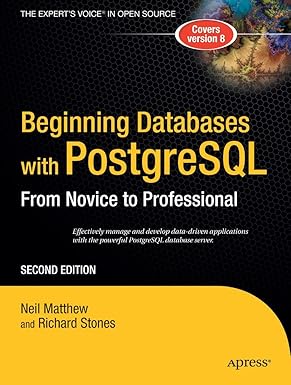
PostgreSQL has emerged as one of the most powerful open-source relational database management systems (RDBMS), widely adopted in enterprise-grade applications due to its robustness, extensibility, standards compliance, and strong performance characteristics. In modern Full Stack Java development, PostgreSQL plays a central role in enabling scalable, secure, and data-intensive applications when combined with Spring Boot on the backend and React on the frontend. This white paper synthesizes concepts from Apress publications, including Beginning Databases with PostgreSQL and Building Modern Business Applications: Reactive Cloud Architecture for Java, Spring, and PostgreSQL, to present a comprehensive research-driven perspective on how PostgreSQL supports full stack application architectures. The paper covers data modeling, transactional integrity, reactive and cloud-native design, REST and GraphQL integration, performance optimization, DevOps considerations, and frontend data consumption through React. The objective is to provide architects, senior developers, and technology leaders with a practical yet research-oriented guide to leveraging PostgreSQL effectively in Full Stack Java systems.
PostgreSQL in Full Stack Java Development- A Research White Paper Integrating Spring Boot and React
Abstract
PostgreSQL has emerged as one of the most powerful open-source relational database management systems (RDBMS), widely adopted in enterprise-grade applications due to its robustness, extensibility, standards compliance, and strong performance characteristics. In modern Full Stack Java development, PostgreSQL plays a central role in enabling scalable, secure, and data-intensive applications when combined with Spring Boot on the backend and React on the frontend. This white paper synthesizes concepts from Apress publications, including Beginning Databases with PostgreSQL and Building Modern Business Applications: Reactive Cloud Architecture for Java, Spring, and PostgreSQL, to present a comprehensive research-driven perspective on how PostgreSQL supports full stack application architectures. The paper covers data modeling, transactional integrity, reactive and cloud-native design, REST and GraphQL integration, performance optimization, DevOps considerations, and frontend data consumption through React. The objective is to provide architects, senior developers, and technology leaders with a practical yet research-oriented guide to leveraging PostgreSQL effectively in Full Stack Java systems.
1. Introduction
Full Stack Java development has evolved significantly over the last decade. Traditional monolithic architectures have given way to microservices, reactive systems, and cloud-native deployments. At the center of this evolution lies the database, which must support high concurrency, complex queries, distributed workloads, and strong consistency guarantees.
PostgreSQL, often described as “the world’s most advanced open-source database,” aligns well with these requirements. Its advanced SQL compliance, extensible indexing, support for JSON/JSONB, and mature ecosystem make it an ideal foundation for Spring Boot–based backend services and React-driven frontend applications.
This white paper explores PostgreSQL not merely as a persistence layer, but as an integral component of system design, business logic enforcement, and data-driven user experiences in Full Stack Java development.
2. PostgreSQL Fundamentals for Application Developers
2.1 Relational Foundations and SQL Compliance
PostgreSQL adheres closely to ANSI SQL standards while extending them with powerful features such as Common Table Expressions (CTEs), window functions, and advanced constraint management. For Java developers, this means predictable behavior, portability of SQL knowledge, and the ability to express complex business rules directly at the database level.
2.2 Data Types and Extensibility
PostgreSQL provides a rich set of built-in data types including numeric, temporal, geometric, network address types, and full-text search vectors. Additionally, developers can define custom data types, operators, and functions, making PostgreSQL highly adaptable to domain-specific requirements.
2.3 ACID Transactions and MVCC
Multi-Version Concurrency Control (MVCC) is a cornerstone of PostgreSQL’s architecture. It enables high concurrency without sacrificing transactional consistency. For Spring Boot applications handling concurrent API requests, MVCC ensures reliable reads and writes without excessive locking.
3. PostgreSQL in Spring Boot Backend Architecture
3.1 Spring Boot and Data Access Layers
Spring Boot simplifies backend development by providing opinionated defaults and auto-configuration. PostgreSQL integrates seamlessly through:
- JDBC and connection pooling (HikariCP)
- Spring Data JPA (Hibernate)
- Spring Data JDBC
- Reactive drivers (R2DBC)
Each approach offers different trade-offs between abstraction, performance, and control.
3.2 Object-Relational Mapping with JPA
Using PostgreSQL with JPA enables developers to map domain models directly to relational schemas. PostgreSQL-specific features such as sequences, UUIDs, and JSONB columns can be effectively leveraged through custom Hibernate types and native queries.
3.3 Transaction Management
Spring’s declarative transaction management aligns naturally with PostgreSQL’s ACID guarantees. Developers can define transaction boundaries using annotations, while PostgreSQL enforces consistency at the storage layer.
4. Reactive and Cloud-Native Architectures
4.1 Reactive Systems and PostgreSQL
Reactive systems emphasize responsiveness, resilience, elasticity, and message-driven communication. PostgreSQL supports reactive architectures through:
- Non-blocking drivers (R2DBC)
- Asynchronous query execution
- Integration with event-driven systems
4.2 Spring WebFlux and PostgreSQL
Spring WebFlux enables non-blocking REST APIs. When combined with PostgreSQL via R2DBC, applications can handle large numbers of concurrent connections efficiently, making this architecture suitable for cloud-native deployments.
4.3 Event Sourcing and CQRS
PostgreSQL is well-suited for event-sourced systems. Its strong consistency, indexing, and JSON support allow event logs, projections, and read models to coexist efficiently within the same database or across multiple schemas.
5. PostgreSQL as a Business Rules Engine
5.1 Constraints and Integrity Enforcement
PostgreSQL supports primary keys, foreign keys, unique constraints, check constraints, and exclusion constraints. These features allow critical business rules to be enforced at the database level, reducing reliance on application-layer validation alone.
5.2 Stored Procedures and Functions
With PL/pgSQL and other procedural languages, PostgreSQL can encapsulate complex logic close to the data. In Spring Boot applications, stored functions can be invoked through JDBC or JPA native queries for performance-critical operations.
5.3 Temporal and Audit Data
PostgreSQL’s support for triggers and temporal modeling enables robust auditing, versioning, and historical data analysis—key requirements in enterprise and regulated systems.
6. Frontend Integration with React
6.1 RESTful APIs and Data Serialization
React frontends typically consume data via REST APIs built with Spring Boot. PostgreSQL-backed services return JSON representations of domain entities, often optimized through DTOs and projections.
6.2 GraphQL and PostgreSQL
GraphQL enables flexible data querying for React applications. PostgreSQL’s relational structure maps well to GraphQL schemas, supporting complex queries, nested relationships, and real-time subscriptions.
6.3 Performance and User Experience
Efficient PostgreSQL queries directly impact frontend performance. Techniques such as pagination, indexing, caching, and query optimization ensure responsive React user interfaces even under heavy load.
7. Performance Optimization Strategies
7.1 Indexing and Query Planning
PostgreSQL offers B-tree, Hash, GIN, GiST, and BRIN indexes. Choosing the right index strategy is critical for high-performance Spring Boot applications serving React clients.
7.2 Connection Pooling and Resource Management
Connection pooling minimizes overhead and improves throughput. HikariCP is commonly used with Spring Boot to manage PostgreSQL connections efficiently.
7.3 Monitoring and Observability
PostgreSQL exposes extensive statistics through system views. Combined with application-level monitoring, this data enables proactive performance tuning and capacity planning.
8. Security and Compliance
8.1 Authentication and Authorization
PostgreSQL supports role-based access control, SSL/TLS encryption, and integration with enterprise authentication systems. These features complement Spring Security in Full Stack Java applications.
8.2 Data Protection and Compliance
Features such as row-level security, encryption, and auditing support compliance with regulations like GDPR and industry-specific standards.
9. DevOps, Deployment, and Cloud Integration
9.1 Containerization and PostgreSQL
Docker-based deployments enable consistent PostgreSQL environments across development, testing, and production. Spring Boot and React applications benefit from reproducible database configurations.
9.2 CI/CD Pipelines
Database migrations using tools like Flyway or Liquibase ensure schema evolution aligns with application releases.
9.3 Cloud-Native PostgreSQL
Managed PostgreSQL services and Kubernetes operators support scalable, resilient deployments for modern Full Stack Java applications.
10. Research Implications and Future Directions
PostgreSQL continues to evolve with improvements in performance, distributed capabilities, and developer tooling. Emerging trends such as AI-driven analytics, real-time data processing, and multi-cloud architectures further strengthen PostgreSQL’s relevance in Full Stack Java development.
11. Role of IAS-Research.com and KeenComputer.com in Full Stack Java & PostgreSQL Projects
11.1 IAS-Research.com: Research-Driven Architecture and Advanced Engineering
IAS-Research.com plays a critical role in bridging academic research, advanced engineering, and real-world system implementation. In PostgreSQL-based Full Stack Java projects, IAS Research can support organizations in the following ways:
- Database Architecture and Data Modeling Research: Designing normalized and scalable PostgreSQL schemas aligned with complex business domains, regulatory requirements, and long-term data growth.
- Advanced PostgreSQL Optimization: Applying research-backed techniques for indexing strategies, query optimization, partitioning, MVCC tuning, and workload analysis for high-concurrency Spring Boot applications.
- Reactive and Cloud-Native Design: Assisting organizations in adopting reactive architectures using Spring WebFlux, R2DBC, and event-driven patterns grounded in modern systems research.
- Applied R&D and Prototyping: Developing proof-of-concept solutions that integrate PostgreSQL with AI/ML pipelines, analytics platforms, and distributed systems.
- Technical White Papers and Knowledge Transfer: Producing research-grade documentation, architectural blueprints, and training materials to enable internal teams and stakeholders.
IAS Research is particularly well suited for enterprises, research institutions, and SMEs that require deep technical rigor, innovation, and future-ready database-backed systems.
11.2 KeenComputer.com: Practical Implementation and Digital Transformation
KeenComputer.com complements research and architecture with hands-on implementation and digital transformation services. In PostgreSQL-driven Full Stack Java initiatives, Keen Computer can help by:
- End-to-End Full Stack Development: Building production-ready applications using PostgreSQL, Spring Boot microservices, and React frontends.
- Enterprise Application Modernization: Migrating legacy systems to PostgreSQL-backed Spring Boot architectures with improved scalability and maintainability.
- DevOps and Cloud Deployment: Implementing CI/CD pipelines, Dockerized PostgreSQL environments, Kubernetes orchestration, and managed cloud database solutions.
- Security and Compliance Implementation: Applying PostgreSQL role-based access control, encryption, auditing, and Spring Security best practices.
- Performance Engineering and Support: Monitoring, tuning, and maintaining PostgreSQL databases and Java application stacks in production environments.
KeenComputer.com focuses on delivery, reliability, and business outcomes, ensuring that PostgreSQL-powered applications move efficiently from design to deployment.
11.3 Joint Value Proposition
Together, IAS-Research.com and KeenComputer.com offer a comprehensive value proposition:
- Research-informed architecture + real-world implementation
- Strategic consulting + hands-on engineering
- Innovation, scalability, and operational excellence
This combined approach enables organizations to adopt PostgreSQL-centric Full Stack Java solutions that are not only technically sound but also commercially viable and sustainable.
12. Conclusion
PostgreSQL is far more than a traditional relational database. In the context of Full Stack Java development, it serves as a strategic platform enabling robust backend services, reactive architectures, and rich React-based user experiences. When combined with Spring Boot, PostgreSQL delivers transactional integrity, performance, and extensibility, while React ensures responsive and user-centric interfaces.
By leveraging the research expertise of IAS-Research.com and the implementation capabilities of KeenComputer.com, organizations can confidently design, build, and scale PostgreSQL-powered Full Stack Java systems that meet modern business, technical, and regulatory demands.
References
- Hans-Jürgen Schönig, Beginning Databases with PostgreSQL, Apress.
- Peter Royal, Building Modern Business Applications: Reactive Cloud Architecture for Java, Spring, and PostgreSQL, Apress, 2023.
- Craig Walls, Spring in Action, Manning Publications.
- PostgreSQL Global Development Group, PostgreSQL Documentation.
- Spring Framework Reference Documentation.
- React Official Documentation.