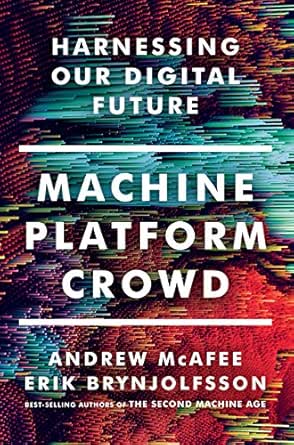
This research white paper synthesizes key ideas from Machine, Platform, Crowd: Harnessing Our Digital Future by Andrew McAfee and Erik Brynjolfsson and applies them to contemporary digital transformation challenges faced by startups and small-to-medium enterprises (SMEs). The paper develops a practical framework for leveraging machine intelligence, digital platforms, and distributed human expertise (the crowd) to build competitive advantage. It further demonstrates how KeenComputer.com and IAS‑Research.com can act as strategic implementation partners across IT infrastructure, software engineering, data analytics, AI, websites, and ecommerce systems. The paper is intended for founders, CTOs, CIOs, and innovation leaders seeking a structured, evidence‑based approach to digital transformation.
Machine, Platform, Crowd: A Research White Paper on Digital Transformation
Abstract
This research white paper synthesizes key ideas from Machine, Platform, Crowd: Harnessing Our Digital Future by Andrew McAfee and Erik Brynjolfsson and applies them to contemporary digital transformation challenges faced by startups and small-to-medium enterprises (SMEs). The paper develops a practical framework for leveraging machine intelligence, digital platforms, and distributed human expertise (the crowd) to build competitive advantage. It further demonstrates how KeenComputer.com and IAS‑Research.com can act as strategic implementation partners across IT infrastructure, software engineering, data analytics, AI, websites, and ecommerce systems. The paper is intended for founders, CTOs, CIOs, and innovation leaders seeking a structured, evidence‑based approach to digital transformation.
1. Introduction: The Triple Revolution
The global economy is undergoing a profound transformation driven by three mutually reinforcing forces: increasingly capable machines, scalable digital platforms, and globally connected crowds of users, contributors, and experts. McAfee and Brynjolfsson describe this as a triple revolution that reshapes how value is created, captured, and scaled.
Traditional industrial models relied on ownership of physical assets, hierarchical organizations, and linear value chains. In contrast, modern digital leaders—from AI‑driven firms to platform‑based ecosystems—operate with lightweight asset structures, software‑centric architectures, and network effects. Understanding this shift is essential for organizations navigating digital transformation.
For SMEs and startups, the triple revolution presents both opportunity and risk. Firms that learn to rebalance mind and machine, product and platform, and core and crowd can compete far beyond their size. Those that do not risk rapid obsolescence.
2. Machines: From Automation to Augmentation
2.1 Beyond Routine Automation
Early digital transformation focused on automating routine tasks such as payroll processing, inventory management, and accounting. While valuable, this represented only the first phase of the second machine age. Today’s machine intelligence—powered by machine learning, deep neural networks, and data‑driven optimization—extends into non‑routine cognitive work.
Examples include:
- Predictive maintenance in manufacturing
- Fraud detection in financial services
- Medical image analysis in healthcare
- Recommendation engines in ecommerce
These systems do not merely follow explicit rules; they learn patterns from data and improve over time.
2.2 Human–Machine Complementarity
A central insight of Machine, Platform, Crowd is that machines rarely replace humans wholesale. Instead, the greatest gains come from complementarity. Machines excel at scale, speed, and pattern recognition; humans excel at judgment, creativity, ethics, and contextual reasoning.
Organizations must therefore redesign workflows to maximize joint performance rather than attempting full automation. Examples include:
- Engineers using AI‑assisted design tools
- Marketers leveraging analytics platforms for segmentation
- Managers using dashboards and decision‑support systems
2.3 How KeenComputer.com and IAS‑Research.com Help
KeenComputer.com supports machine‑enabled transformation by:
- Designing scalable IT infrastructure (cloud, hybrid, on‑prem)
- Implementing data pipelines and analytics platforms
- Integrating AI/ML solutions into business applications
IAS‑Research.com contributes through:
- Advanced analytics and modeling
- Applied AI research and prototyping
- Domain‑specific machine learning solutions for engineering, energy, and industrial systems
Together, they help organizations move from basic automation to intelligent augmentation.
3. Platforms: From Products to Ecosystems
3.1 The Rise of Platform Business Models
Platforms differ fundamentally from traditional products. A product delivers value directly to the customer, while a platform enables interactions among multiple participants—producers, consumers, developers, advertisers, or service providers.
Examples include:
- Uber connecting drivers and riders
- Airbnb connecting hosts and guests
- Shopify enabling merchants and app developers
Platforms benefit from network effects: the value of the system increases as more participants join.
3.2 Products Still Matter
The authors emphasize that platforms do not eliminate products; rather, they change their role. Successful platforms still depend on high‑quality products and services at their core. The strategic question becomes whether to scale primarily through internal production or external participation.
For SMEs, platform thinking can be applied incrementally:
- Marketplaces layered onto existing ecommerce systems
- APIs that allow partners to integrate
- Content platforms built around communities
3.3 Digital Platforms and Ecommerce
Modern platforms rely on robust digital foundations:
- CMS systems (WordPress, Joomla)
- Ecommerce engines (Magento, WooCommerce)
- Mobile apps and APIs
- Payment, logistics, and analytics integrations
3.4 How KeenComputer.com and IAS‑Research.com Help
KeenComputer.com enables platform strategies by:
- Building scalable websites and ecommerce platforms
- Developing custom plugins, APIs, and integrations
- Ensuring security, performance, and SEO readiness
IAS‑Research.com adds value by:
- Platform analytics and experimentation frameworks
- Data‑driven personalization and recommendation systems
- Research‑based evaluation of platform economics and network effects
4. Crowd: Leveraging Distributed Intelligence
4.1 From Core to Crowd
Traditional firms relied on a tightly controlled internal core of employees, suppliers, and partners. Digital connectivity has expanded the feasible boundary of collaboration, enabling organizations to tap into global crowds for ideas, labor, funding, and feedback.
Examples include:
- Open‑source software communities
- Crowdsourcing platforms
- Crowdfunding campaigns
- Online innovation challenges
4.2 Wisdom, Diversity, and Scale
Crowds can outperform experts under certain conditions, particularly when:
- Participants are diverse
- Contributions are independent
- Aggregation mechanisms are effective
However, crowds require careful design to avoid noise, bias, and manipulation.
4.3 Organizational Implications
Leveraging the crowd does not eliminate the need for strong internal capabilities. Instead, leaders must decide:
- What to keep in the core
- What to open to external contributors
- How to govern participation
4.4 How KeenComputer.com and IAS‑Research.com Help
KeenComputer.com supports crowd‑enabled strategies through:
- Community platforms and forums
- Collaboration tools and portals
- Secure integration of external contributors
IAS‑Research.com provides:
- Research methodologies for crowdsourcing and open innovation
- Evaluation of crowd quality and incentives
- Governance models balancing openness and control
5. Rebalancing the Organization
5.1 Mind and Machine
Organizations must invest not only in technology but also in skills, training, and change management. Human capital development remains critical in a machine‑rich environment.
5.2 Product and Platform
Strategic leaders should evaluate where platform leverage can amplify existing products and where product excellence remains the primary differentiator.
5.3 Core and Crowd
A deliberate approach to openness enables innovation without eroding strategic coherence.
6. Implementation Roadmap for SMEs
- Assess digital maturity across machines, platforms, and crowds
- Modernize infrastructure (cloud, data, security)
- Digitize core processes with analytics and automation
- Develop platform capabilities (web, ecommerce, APIs)
- Engage external ecosystems (partners, communities, customers)
- Measure and iterate using data‑driven feedback loops
KeenComputer.com and IAS‑Research.com jointly support this roadmap from strategy through execution.
7. Conclusion
The machine–platform–crowd framework offers a powerful lens for understanding digital transformation. Rather than viewing technology as a threat, organizations should see it as an opportunity to rebalance capabilities and unlock new forms of value creation. With the right strategy and implementation partners, SMEs and startups can thrive in the second machine age.
References
- McAfee, A., & Brynjolfsson, E. Machine, Platform, Crowd: Harnessing Our Digital Future. W. W. Norton & Company.
- Brynjolfsson, E., & McAfee, A. The Second Machine Age. W. W. Norton & Company.
- Porter, M. E. (1985). Competitive Advantage. Free Press.
- Varian, H. (2019). Artificial intelligence, economics, and industrial organization. Journal of Economic Perspectives.
- Tapscott, D., & Williams, A. (2006). Wikinomics. Portfolio.
- Chesbrough, H. (2003). Open Innovation. Harvard Business School Press.
- KeenComputer.com – Digital Transformation and IT Services.
- IAS‑Research.com – Applied Research and Advanced Analytics.